The Architecture Logic of Biblical Creation: programmer’s POV
Tags: System Design, Linguistics, Philosophy, Ancient History, C++, OOP
In short: What if Biblical Creation wasn’t about “making” stuff ?
Disclaimer:
This is NOT a religious discussion. I’m not trying to question the Bible. I’m trying to question my own perception of it through a “reverse engineering” approach aiming to find an underlying logic—an attempt to see the “hardware” behind the UI facing us.
- Religion and Science are the two foundational pillars our Civilization rests upon, and both deserve equal RESPECT.
I am convinced that every story and legend (including religious ones and fairy tales) is inspired by some actual events that often reached us distorted and having lost their original meaning, which makes identifying them nearly impossible.
Nevertheless, below is my attempt to do so.
Creation stories in different religions share a similar pattern:
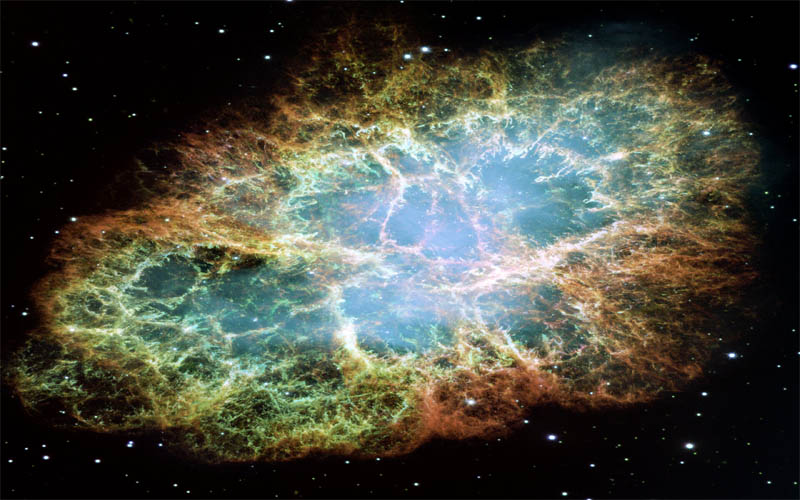
- Some form of the Universe already pre-existed before Creation in a form of Chaos.
- God existed before Creation as well.
- Then God starts Creation by breaking Chaos into pieces—separating Light from Darkness, Earth from Heaven (firmament from sky). While the specific steps vary, the first one is always the same: setting initial boundaries, which Chaos can’t have by definition.
- Then from each generic concept (such as Earth and Heaven) God creates everything else. Like animals and trees – from “Earth”, Sun and Moon – from “Sky”, and so on, increasing the specificity of subjects with each iteration, ending up by the Creation of people.
- Everything happens pretty quickly (around a week).
All this suggests that these stories have the same or similar origins. I dare to suggest that the origin is the emergence of language and speech as a new level of consciousness and mind, as the formation of a new ABSTRACT layer of world perception, formalized in WORDS.
Thus, the process of Creation appears as a process of conscious comprehension of the World, dividing it into categories, concepts and terms. From the most generic to more detailed and specific ones.
A logical chain, a multi-step process with its own intermediate and temporary “classes”—concepts, some of which have occasionally reached us in the form of mythic creatures with blurred boundaries. The presence in our culture of these half-humans, half-animals, or half-gods (like Leviathan, Behemoth, or Giants) confirms this theory.
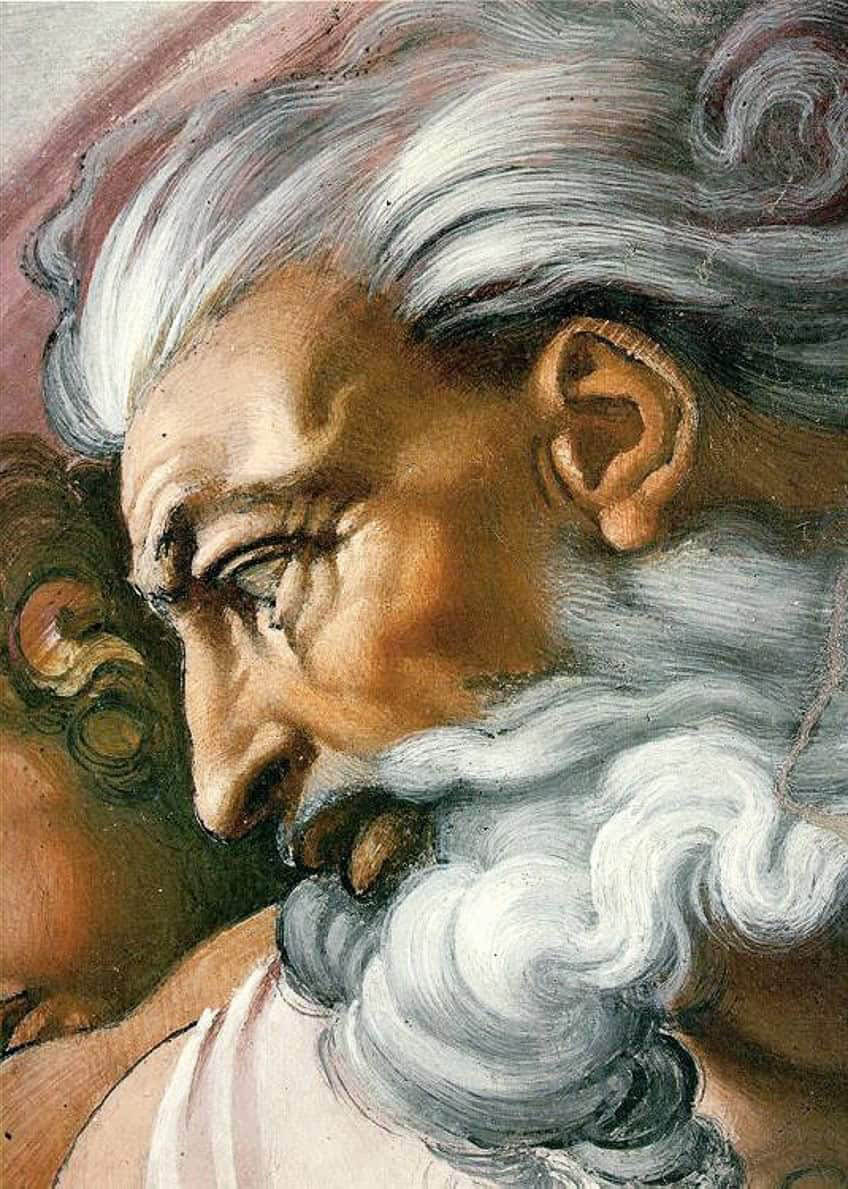
Actually, there is a direct reference to this event in the Holy Scriptures, in the Gospel of John for example. John 1:1: “In the beginning was the Word, and the Word was with God, and the Word was God.”
Never could truly comprehend it despite the subsequent explanation in John. This statement always seemed way too allegorical to me until I tried to read it literally.
As I understand now, it refers to the emergence of speech from the moment the first word (concept) was born (“In the beginning was the Word”). And this first word (as suggested) was “God” (“and the Word was God”), which meant at that moment just everything including “myself”, just like “Ku” in the cult sci-fi Kin-dza-dza, or a root pointer in programming, essentially a universal “placeholder” term for everything else. So, whoever invented this first word was the bearer of it, and for him it was a self-designation too (“and the Word was with God”).
- Just a reminder: we are talking about times LONG before John, before Monotheism, even before Paganism, when “gods” could be more “down-to-earth” than we are accustomed to thinking.
Why “In the beginning“? Does this mean that nothing existed before? Existed, but just wasn’t “counted.” This first Word (“God”) simply opened a countdown, it was a beginning of the conscious humankind era. And the first few days of this new era were dedicated to breaking down this super-universal concept into more specific areas and terms, like “Sky”, “Earth”, “human”, and so on.
The memory of mankind has preserved this revolutionary event in the form of legends about the Creation of the world. With this assumption, the 6 days of Creation around 6000 years ago seem quite convincing and justified.
But why “Creation”, why not just “naming”? Well, it was such a DRAMATIC Mindshift, that initially and for a long time after, humanity was simply unable to distinguish a thing from its verbal equivalent. Whoever possessed the word, possessed what it meant as well. Thus, the invention of the Word = Creation. Before a thing is named, it doesn’t really exist for your attention, being fully blended with the background. The long era of magic and sorcery was just beginning.
By the way, what is witchcraft and sorcery in reality? It’s an ability to affect surrounding world by WORDS (curses and spells). In essence, it is not an influence on the physical world, but an influence on a client’s perception of it. The Magic is not about forcing the dead to walk, it’s about forcing YOU to believe you saw the dead walking: “Perception is reality”, “The Name is the Thing”, etc. Its modern remnants are hypnosis and other “extra-sensority”, including our newer “invention”—Social engineering…
Memories of those times can be found in ancient literature. For example, in the Finnish epic Kalevala, there is an episode describing a battle between two sorcerers, Väinämöinen and Joukahainen, that caused the earth to shake and writhe. But what was the ‘battle’? They SANG. It was a competition over who knew/possessed more words—and, consequently, more power over their reality.
Even now familiarity with terminology is often equated with mastery of the subject.
Or the Chinese concept of Tao, a direct reference to the pre-verbal perception of the world (true knowledge). “The Tao is eternally nameless and should be distinguished from the countless named things that are considered to be its manifestations, the reality of life before its descriptions of it.”
I recognize such interpretation might seem unconventional, especially from my own perspective as a Christian, but we are talking about a time when humanity was just beginning to speak, and the concept of God in our modern sense as a Creator Father had not yet taken shape.
This approach also helps shed light on some other Bible passages. For example:
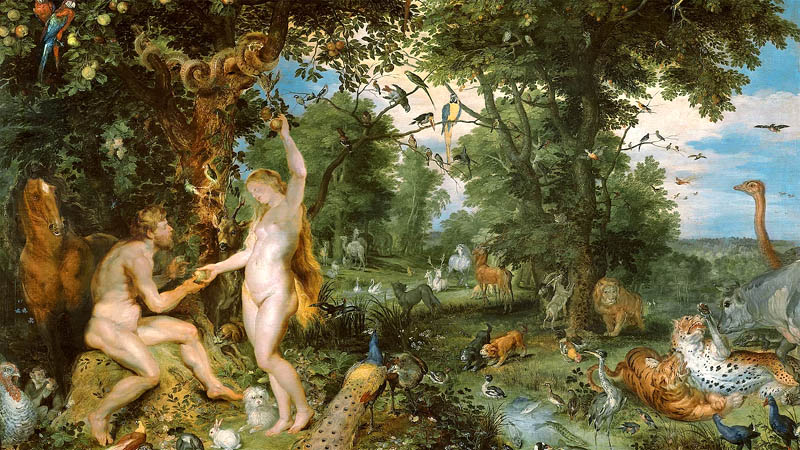
Why were Adam and Eve created from different materials? Adam – from clay, and Eve – from Adam’s rib?
Because the concept of “human” was derived from the more generic concept of “Earth” (clay), which does not mean (IMO) that man was actually molded from clay, it defines concepts hierarchy, while the term “woman” is a descendant of the more generic concept “human”.
How did Adam and Eve populate the world if they had 2 sons and no daughters? Whether they had more children or not, my theory suggests that Adam and Eve were not the ONLY Homo Sapiens in the world, but just the only ones named “humans”.
What was the primordial “Chaos”? The same World as we know it, just not yet conscious, formulated and structured. Which makes it look like a chaotic mixture of nameless unrelated entities. Don’t cats, dogs and other animals see it that way?
In fact, this theory views Chaos in its most literal sense: as an unorganized state of existence where the act of Creation establishes a coherent Order.
So, this was the event that separated Humanity from the rest of the living world and determined all its further development. The true Greatness of it makes this Story essentially Divine and highly Sacred.
Ironically, John’s message wasn’t even “encrypted”—we just lost the ability to read it.
We even have a hint of WHEN it happened: according to Hebrew scholars—Tuesday, October 6, 3761 BC—the starting point of the Biblical chronology from “World Creation” (the Molad Tohu or Anno Mundi in Latin), roughly 6000 years ago.
Some may try to dispute this date’s accuracy, but to me it seems quite convincing and trustworthy, since it perfectly aligns with archeological “Dawn of History“, a “sudden” appearance of complex societies and advanced civilizations around and after this date, but not before, the shift from isolated sites to vast expandable kingdoms.
The Prototype Civilizations
One might point to sites like Göbekli Tepe, Jericho, or Mohenjo-Daro—some dating back 10,000 to 12,000 years—as an argument that “Creation” is much older than the Bible suggests. However, I think they could have their own “Creations”, which in this architectural context, could be more like early-version pre-mature dead-end Projects. They appeared, flourished (or struggled?) for a while without expansion, and vanished without a trace and visible reason, failing to survive as a continuous logical chain. IMO, not because of “bad luck”, but because the Failure is an “embedded function” of an insufficient protocol. They were “ships launched to sink”, whose wrecks served as bricks for upcoming generations.
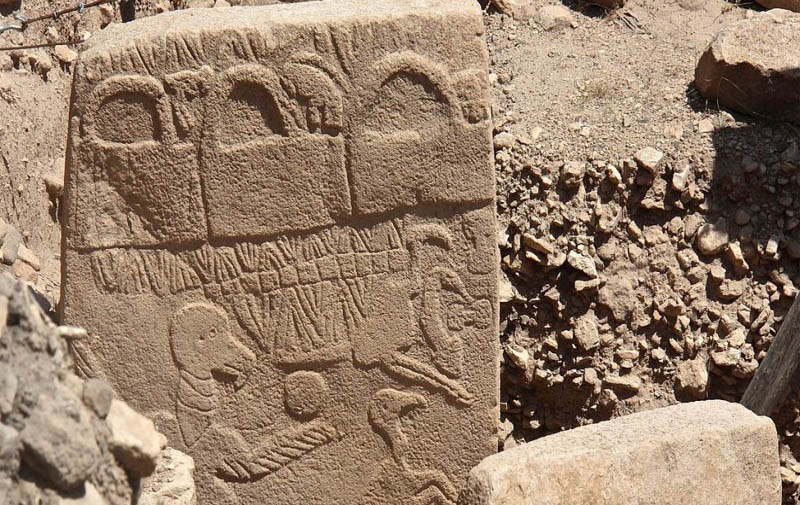
Or why some other civilizations stuck in their early development stages?
Well, the Project evolution and survival are determined by the integrity of its initial protocol.
Perhaps proto-languages (and maybe even proto-writings) were around for millennia, and the “hardware” (brain) was in place for at least 100,000 years, but software (language) had to evolve too, from “Hello World” to “local scripts” to a scalable System.
The “Creation” 6,000 years ago probably wasn’t the first one, but undisputedly—Successful—the system became self-sustainable, and achieved the “escape velocity” that led directly to us.
The Babel Tower
Can foresee an objection: Doesn’t your theory imply we ALL should have a single unified language across entire Civilization, while reality is a bit different?
A perfectly valid argument, that has puzzled me too. Here I’ll try to challenge my own above conclusions.
If we read John’s sentence as literally as we did above, then yes, supposedly. But…
if we try to read it even MORE literally…
the catch is that in the original Greek, the word is “Logos“, which means not only “Word”, but also ‘LOGIC’, ‘REASON’, ‘SENSE’, ‘MEANING’. Which shifts my understanding of Creation from a purely phonetic implementation towards the deployment of a Global Categorization Model, a matrix of MEANINGS. It’s like migrating a hard-coded Assembly legacy build to a system of C++ classes.
So, this wasn’t just setting a phonetic label “God”—but the invention of the Concept itself as a root for entire branching tree of meanings, many of which didn’t even exist yet. A spark that ignited a realization of the internal logic of “Chaos”. Like switching from flat array of hard-coded entities to a hierarchical tree of classes.
To put this in non-coder terms: Not all languages are structurally alike. To understand the difference, try to imagine a primitive uncategorized “flat list” language/protocol, where each entity MUST have own name/label/id, including animals, like Baloo, Bagheera, Kaa, etc. You can’t address another bear as Baloo, no, Baloo – is only that particular bear, when the word/category “bear” doesn’t even exist in your mental map/vocabulary. You yourself in this model are just another entity/name, the same as Bagheera or Baloo, you are not a separate category, but an “organic part of Mother-Nature” (irony). Your protocol’s coverage is limited to what you can actually see and touch, and to people you personally know. Besides, neighboring tribe’s protocol doesn’t match yours—not even close. That’s what lack of scalability and portability looks like. That’s why proper categorization is such a big deal.
When in primitive “list” it’s just “Baloo”, in advanced “tree” implementation it’s – Animal-Bear-Baloo. Seems obvious, but consider improper categorization: NoTail-HoneyLover-Baloo – might work to some extent, but will eventually fail, since in this classification Bagheera won’t be treated the same way as Baloo, while Mowgli – certainly will (likely – hunted and killed). To survive in such a society, you had better be a proven “HoneyHater” (maybe a “Jericho-like” case?).
Q: How could Bagheera be treated “differently” than Baloo?
A: Don’t know, maybe worshipped, like in ancient Mexico?..
BTW, biologically-correct “Animal-Mammal-Primate-Human” model won’t really work either due to a lack of “compatibility.” In this “We are all parts of Nature” Greenpeace-ish “Barbie-world” of friendly rhinos and vegan sharks, many of your new “classmates” would still keep you on their “Delicious-Nutritious” list.
- It is important that in our “Creation”, “human” concept is derived directly from “Earth” (clay), while in Mayan for instance – from “Corn” (generalized concept of “Living Being”) with “Jaguar” rulers subclass (concept of “Power”). We all know their sad fate, whose magnificent imperial-scale cities were abandoned 5 centuries before Columbus.
This brings us back to the “Tower”: While early “scripts” could serve a tribe, the new Protocol allowed to serve entire Ethnos (Nation), but still wasn’t unified (portable) enough to serve us ALL.
Nevertheless, it had a HUGE advantage: scalability, an embedded “Global Matrix of MEANINGS”, the underlying “Interface Definition”, which allowed multiple localized instantiations. It’s no longer about the sounds we make, but about the Schema we share.
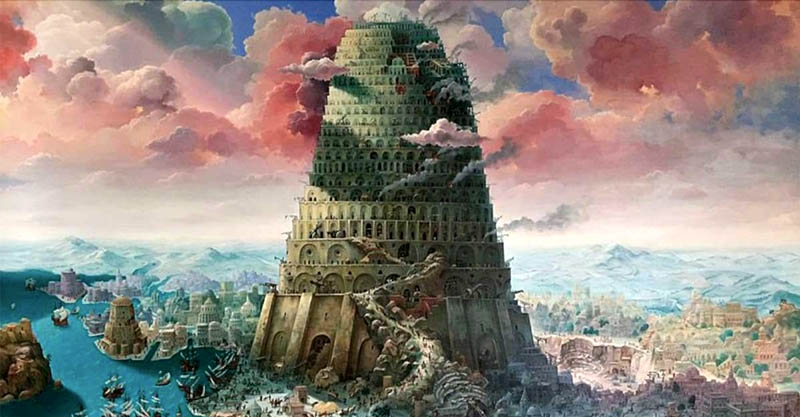
To continue the software development parallels: an Abstract Class, scalable across different geographies without breaking the core logic of the Civilization.
From this perspective, the Tower of Babel Story suddenly transforms from a “punishment” or failure into a TRIUMPH of GLOBAL API.
Looking Ahead: The “Upcoming Protocol”
The emergence of AI seems like a logical and inevitable consequence – establishing an Order in our existing Order’s Chaos, the final step in the deployment of the Word.
Well, it is very possible that I am wrong, please be lenient with me, but so far I do not see obvious logical discrepancies. If you do, please let me know, I will be very grateful.
Citations:
- The Book of Genesis
- Gospel of John
- Elias Lönnrot. “Kalevala“
- Laozi (Lao Tzu). “Tao Te Ching“
- Rudyard Kipling. “The Jungle Book“
- Popol Vuh (the Mayan “Bible”)